
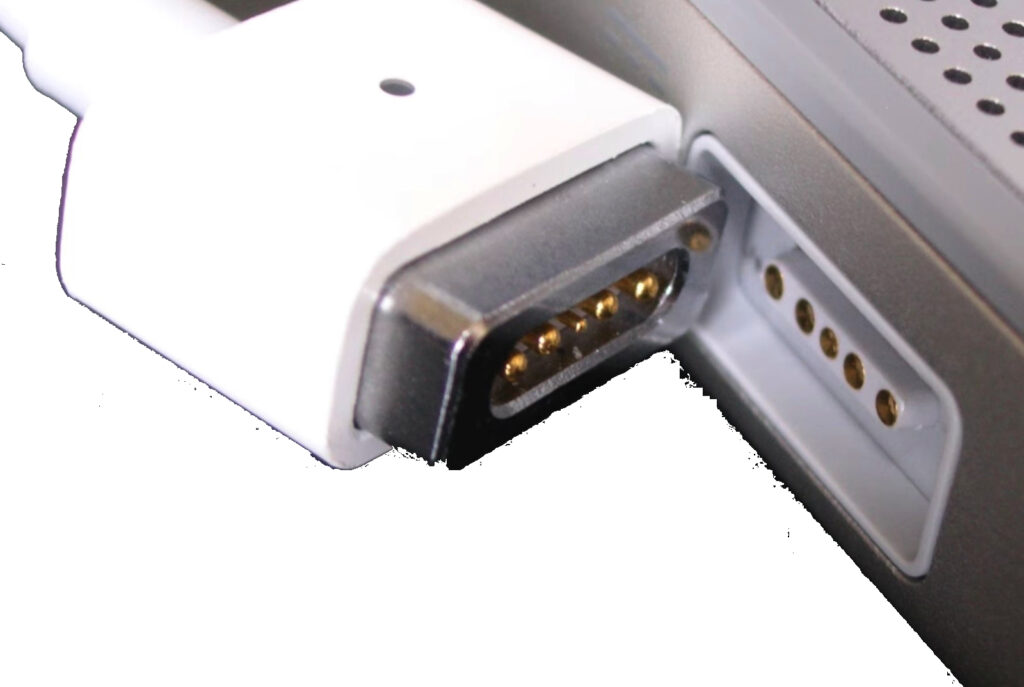
A MagSafe 1 or MagSafe 2 adapter is a magnetic power connector used to charge certain older laptops made by Apple, specifically models of the MacBook, MacBook Air, and MacBook Pro produced roughly between 2006 and 2017. The connector attaches magnetically to the laptop’s charging port, allowing it to snap into place easily and detach safely if the cable is pulled, which helps prevent the computer from being dragged off a desk. MagSafe 1 has a thicker, T-shaped or L-shaped connector used on earlier models, while MagSafe 2, introduced in 2012, is thinner and wider to match the slimmer designs of later MacBook Air and Retina MacBook Pro models. Both adapters convert AC wall power into the lower-voltage DC power required by the laptop while also charging the internal battery.
MagSafe 1 and MagSafe 2 were not broadly licensed by Apple to third-party manufacturers. Apple designed and controlled the MagSafe connector ecosystem used on the MacBook, MacBook Air, and MacBook Pro from 2006–2017, and unlike the later MagSafe Charger for iPhones or the Made for iPhone (MFi) Program used for Lightning accessories, there was no widely publicized licensing program that allowed companies to manufacture fully certified MagSafe 1 or MagSafe 2 power adapters. As a result, genuine adapters were produced by Apple itself, while many third-party replacements exist but are typically unlicensed aftermarket products that replicate the connector rather than being officially certified by Apple.
Using a third-party MagSafe 1 or MagSafe 2 power adapter with a laptop made by Apple—such as a MacBook Pro or MacBook Air—can sometimes work perfectly well, but there are several potential issues to be aware of. Because Apple did not broadly license these connectors to outside manufacturers, many replacement chargers are reverse-engineered rather than officially certified. As a result, the internal components—such as voltage regulation, shielding, and the communication chip that allows the computer to recognize the adapter—can vary widely in quality. Lower-quality units may charge more slowly, fail to power the computer under heavy load, or display warnings like “battery not charging.”
Another common issue involves reliability and durability. Some third-party adapters use cheaper wiring, weaker magnetic connectors, or lower-grade insulation. Over time this can lead to fraying cables, overheating power bricks, or intermittent charging where the connection drops if the cable moves slightly. In some cases, the LED indicator in the MagSafe connector may behave inconsistently or not function at all because the internal circuitry is not identical to Apple’s original design.
Safety can also be a concern with poorly made chargers. Inexpensive adapters sometimes omit protections that regulate current, prevent overheating, or handle electrical surges properly. While many reputable third-party manufacturers produce safe power supplies, very cheap models may run hotter than the original Apple adapter or have inadequate insulation and grounding. For that reason, it is generally safer to purchase replacements from well-known brands or refurbished genuine Apple adapters rather than the lowest-cost options.
When shopping on marketplaces like Amazon, many replacement MagSafe 1 and MagSafe 2 chargers are designed to closely resemble genuine adapters made by Apple for the MacBook Pro and MacBook Air. Because some third-party manufacturers intentionally mimic Apple’s appearance, distinguishing them requires looking at several details in the listing and product photos.
1. Branding and labeling
A genuine Apple adapter will clearly show the Apple logo and precise regulatory text molded or printed on the power brick. It will usually say something like “Designed by Apple in California” and list the exact wattage (45W, 60W, or 85W) along with a model number. Listings that avoid showing the label area, blur it out, or show text that looks slightly different from Apple’s typical layout are often third-party chargers.
2. Product description language
Third-party listings frequently use phrases such as “compatible with”, “replacement for”, or “for MacBook” rather than stating that the product is made by Apple. If the listing brand is not Apple—or if the brand name is unfamiliar—then it is almost certainly not a genuine adapter even if the photos look identical.
3. Price differences
Authentic adapters from Apple are typically much more expensive than generic replacements. If a charger that appears to be a genuine Apple MagSafe adapter is selling for a fraction of the usual price, it is very likely an aftermarket product.
4. Packaging and included materials
Original Apple adapters come in Apple-style packaging with documentation and carefully organized cables. Third-party products often arrive in generic boxes, plastic bags, or packaging branded by another company.
5. Seller and product reviews
Checking the seller information and reading reviews can also reveal clues. Buyers often mention whether the adapter is genuine Apple hardware, refurbished, or an aftermarket copy.
In practice, the most reliable indicator is simply whether the listing explicitly names Apple as the manufacturer and seller. If the brand field does not say Apple—even if the adapter looks identical—it is almost certainly a third-party replacement rather than an original Apple MagSafe charger.
A poorly made third-party MagSafe 1 or MagSafe 2 adapter can potentially damage a laptop such as a MacBook Pro or MacBook Air made by Apple, although the risk depends heavily on the quality of the adapter. Power supplies must deliver stable voltage and current while communicating correctly with the Mac’s charging circuitry. Some inexpensive or poorly engineered adapters lack proper voltage regulation, filtering, or protective circuitry. If the output fluctuates, spikes, or overheats, it can stress internal components such as the charging controller, battery, or logic board over time.
Another risk involves electrical protection features. Genuine Apple adapters typically include safeguards such as over-current protection, thermal shutdown, and better insulation. Lower-quality third-party units sometimes omit or simplify these protections to reduce cost. In extreme cases this can lead to overheating, melted connectors, or electrical faults that may damage the charging port or battery system.
That said, not all third-party adapters are dangerous. Some reputable manufacturers produce high-quality replacements that match Apple’s electrical specifications and operate safely. The main risk comes from very cheap or counterfeit chargers designed to look like Apple products but built with lower-grade components. For this reason, many technicians recommend either using a genuine Apple adapter or purchasing replacements from reputable brands rather than unknown, very low-cost options.
Many of the same types of issues can also occur with third-party MagSafe 3 or iPhone MagSafe adapters, and sometimes additional issues arise. The reason is that most wireless magnetic charging products only work reliably if they closely follow Apple’s technical and safety standards. Apple has a “Made for MagSafe” (MFM) certification program, which ensures that accessories are tested for alignment, power delivery, magnetic strength, and safety. Many third-party products, however, are only labeled as “MagSafe compatible,” meaning they use a ring of magnets but do not implement the full MagSafe power and communication protocol. These adapters often charge at lower speeds, and their behavior can be unpredictable.
Third-party adapters frequently have slower charging or inconsistent power delivery. They may fail to properly negotiate power with the iPhone, resulting in intermittent connection or reduced output. Some uncertified chargers also struggle to maintain stable magnetic alignment or manage heat effectively, leading to repeated disconnects or charging throttling to protect the battery. Poor-quality third-party accessories may also use substandard power regulation components, which can create excess heat and potentially stress the battery over time. In extreme cases, very cheap or fake adapters may lack internal safeguards, introducing safety risks that Apple-certified products are designed to prevent.
Another common issue is misalignment. Non-certified MagSafe accessories sometimes have weaker magnets or incorrectly positioned charging coils, which can cause the charger to slip or fail to maintain a stable connection. In addition, iPhones may not fully recognize non-certified accessories, meaning the MagSafe icon may not appear, charging speeds may be slower, and firmware-related features may not function. Certified Apple or MFM accessories, on the other hand, provide proper power negotiation, stable alignment, and full iOS integration, including firmware updates when necessary.
In summary, many of the same issues exist with third-party MagSafe 3 or iPhone MagSafe adapters, particularly if they are not Made for MagSafe certified. These issues include slower or inconsistent charging, unstable magnetic connection, heat management concerns, and lack of full iPhone integration. Using certified accessories from reputable brands minimizes these risks and ensures a more reliable and safe charging experience.


