
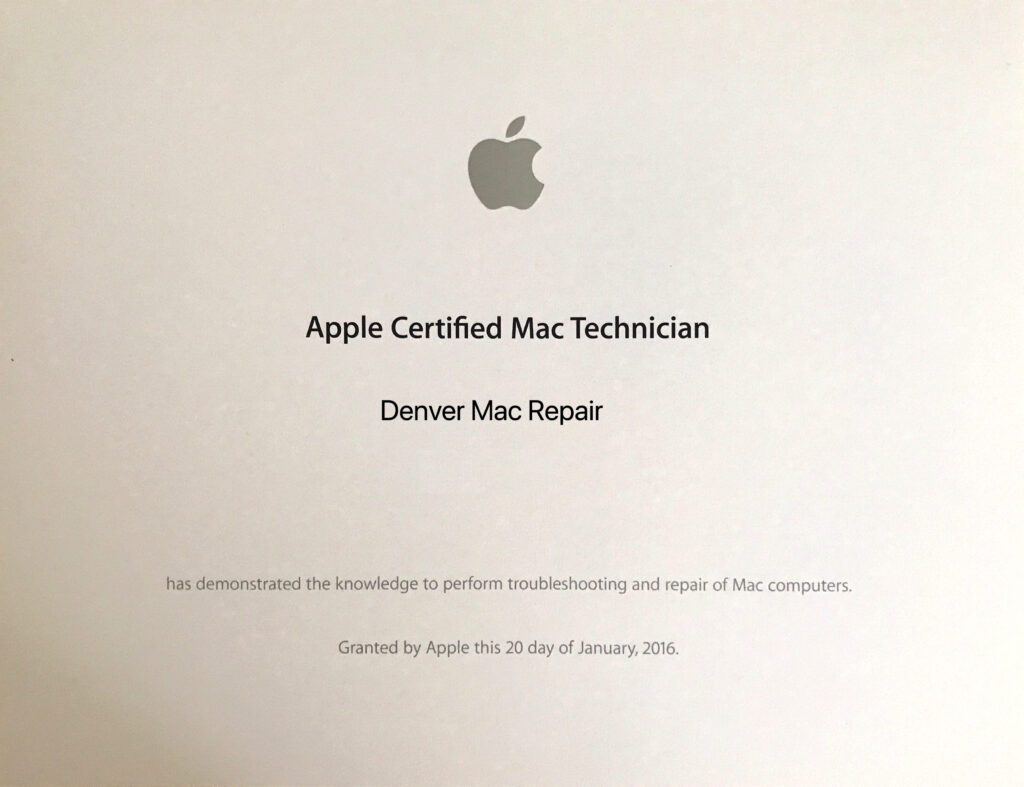
An ACMT (Apple Certified Macintosh Technician) is a professional certification issued by Apple Inc. that validates a technician’s ability to diagnose, service, and repair Apple hardware such as Mac computers according to Apple’s official standards. Individuals who earn the ACMT credential demonstrate proficiency in areas like system diagnostics, hardware replacement, safety procedures, and the use of Apple’s proprietary tools and documentation. This certification is typically required for technicians working at Apple Authorized Service Providers or organizations that perform sanctioned repairs, ensuring that they meet Apple’s strict quality and reliability benchmarks when handling customer devices.
Buying a refurbished Mac from an ACMT (Apple Certified Macintosh Technician)—a credential issued by Apple Inc.—matters because it directly affects the reliability, accuracy, and long-term viability of the machine you’re purchasing. An ACMT is trained to follow Apple’s official diagnostic workflows rather than guesswork, which means the computer has been evaluated using the same service methodologies applied at authorized repair centers. That typically includes full hardware diagnostics, verification of logic board health, proper thermal behavior, battery condition analysis, and validation of all I/O components like ports, Wi-Fi, and cameras.
More importantly, an ACMT understands failure patterns specific to Apple hardware—for example, known issues with certain MacBook keyboards, SSD wear characteristics, or power delivery subsystems—and can proactively address them rather than simply reacting to obvious defects. Repairs and replacements are performed to Apple specifications, using either genuine parts or components that meet equivalent standards, and are installed with the correct procedures (including torque specs, adhesive application, and calibration steps where required). This reduces the risk of subtle issues like improper display seating, battery misalignment, or thermal inefficiency that often show up in lower-quality refurbishments.
There’s also a data integrity and firmware layer that often gets overlooked. An ACMT is trained to properly handle things like firmware restoration, T2/Apple silicon security considerations, and clean OS installs without leaving behind residual user data or misconfigured system settings. That translates into a Mac that behaves like a clean, stable baseline system rather than one with hidden software inconsistencies.
Finally, buying from an ACMT-backed refurbisher usually means accountability—a warranty, documented work, and a repeatable service standard. You’re not just buying a used Mac that “powers on”; you’re buying a system that has been methodically validated against Apple’s service criteria. In practical terms, that lowers your total cost of ownership by reducing early failures, unexpected repairs, and performance inconsistencies.
Buying a Mac from peer-to-peer marketplaces like Facebook Marketplace, Craigslist, or eBay can look like a great deal—but the risk profile is significantly higher than most buyers realize. The core issue is that these platforms are unregulated, seller-dependent environments, meaning there’s no consistent quality control, no guaranteed recourse, and very limited verification of what you’re actually buying.
The biggest risk is fraud and misrepresentation. Listings frequently use stock photos or misleading descriptions, and in some cases the product doesn’t exist at all. Scammers often push for irreversible payments (Zelle, cash, gift cards), and once the money is gone, it’s effectively unrecoverable. Peer-to-peer marketplaces account for a large share of electronics fraud, with fake listings, non-delivery, and bait-and-switch tactics being common.
Closely related is the risk of hardware problems that aren’t disclosed. A Mac might boot up fine during a quick check but still have underlying issues—degraded battery, failing SSD, thermal problems, or logic board instability. Many sellers either don’t test thoroughly or intentionally hide defects, and without proper diagnostic tools, you’re buying blind.
Another major concern—especially with Macs—is iCloud / Activation Lock and ownership issues. If a Mac is still tied to the previous owner’s Apple ID, it can become partially or completely unusable. Even worse, some devices are stolen; buying one can lead to the system being remotely locked or even confiscated.
Then there’s the complete lack of warranty or return policy. On platforms like Craigslist and Facebook Marketplace, sales are typically final—no refunds, no support, no accountability if the device fails the next day. Even on eBay, while there is some buyer protection, it doesn’t cover every scenario, especially if issues aren’t immediately obvious.
You also take on data security and software risks. If the Mac hasn’t been properly wiped or reinstalled, it could contain leftover data, misconfigured firmware, or even security vulnerabilities. This is something most casual sellers don’t handle correctly.
Finally, there’s a broader structural issue: no standard of refurbishment. Anyone can claim a Mac is “refurbished” or “like new,” but there’s no requirement that it’s been tested, repaired, or validated in any systematic way. That’s the fundamental difference between a random seller and a certified technician—you’re either getting a verified system, or you’re gambling.
In practical terms, buying from these platforms isn’t automatically a bad decision—but it is a risk-transfer decision. You’re trading a lower upfront price for higher uncertainty, higher potential failure rates, and essentially zero post-sale protection.
Buying a Mac from a pawn shop or a general PC repair shop sits somewhere between a private sale and a professional refurbishment—but there are still meaningful risks, mostly tied to inconsistent standards and limited Apple-specific expertise.
The primary issue is lack of Apple-centric diagnostic rigor. Unless the shop employs an ACMT (Apple Certified Macintosh Technician) through Apple Inc., they’re typically not using Apple’s official diagnostic suites or service workflows. That means critical subsystems—like logic board integrity, thermal performance, battery health calibration, or SSD wear—may not be fully evaluated. Many PC-focused shops are highly competent with Windows hardware but don’t always account for the nuances of macOS firmware, T2/Apple silicon security layers, or Apple-specific failure patterns.
There’s also a parts quality and installation risk. Repairs may be done with third-party or salvaged components that vary widely in quality. For example, a display might technically function but have lower brightness or color accuracy than original spec, or a battery may report as “good” but lack proper cycle calibration. Without Apple-standard installation procedures (adhesive alignment, torque specs, sensor pairing), you can end up with subtle reliability issues that only show up over time.
Another concern is incomplete refurbishment. Pawn shops, in particular, often operate on a resale model rather than a refurbishment model—they verify that the device powers on and functions at a basic level, but they don’t typically perform deep testing, preventative maintenance, or component replacement. PC repair shops may go further, but their process is rarely standardized unless they specialize in Apple hardware.
You also have to consider device history and sourcing. Pawn shops may acquire inventory from a wide range of sellers, and while they follow legal intake procedures, they don’t always have full visibility into how the Mac was used, maintained, or stressed. That uncertainty can translate into hidden wear—especially on components like SSDs and batteries that degrade with usage patterns, not just age.
Then there’s software and security handling. If the Mac hasn’t been properly wiped and reinstalled using correct macOS procedures, you could inherit firmware inconsistencies, residual user data, or incomplete system resets. This is especially relevant on newer Macs where secure boot and activation states matter.
Finally, warranty and accountability are often limited or vague. Some shops offer short return windows or store warranties, but these are usually narrower in scope than what you’d get from a specialized refurbisher. If a latent issue surfaces after that window, you’re likely covering the repair cost yourself.
In practical terms, the risk isn’t that every pawn shop or PC repair shop sells bad Macs—it’s that quality is highly variable and dependent on the individual shop’s expertise and process discipline. Without Apple-specific training and standardized refurbishment procedures, you’re relying on best effort rather than a repeatable, verifiable standard.
Buying a refurbished Mac from a shop that employs ACMTs (Apple Certified Macintosh Technicians)—like Denver Mac Repair or Boulder Mac Repair—fundamentally changes the transaction from a “used electronics purchase” into a controlled, standards-based refurbishment process. That difference shows up in several concrete advantages.
First, you get Apple-spec diagnostic validation, not just basic functionality checks. Shops like these explicitly state that their machines are inspected against Apple diagnostic standards and fully tested before sale. This means the Mac isn’t just turning on—it has passed structured testing of core subsystems (logic board, storage, thermals, sensors), which dramatically reduces the likelihood of latent hardware failure.
Second, there is process consistency and rebuild quality. These shops fully refurbish devices—cleaning, rebuilding, and optimizing them with a fresh OS install—rather than simply reselling them. That implies a repeatable workflow: disassembly where necessary, component-level inspection, proper reassembly, and system-level validation. In technical terms, you’re buying a machine that has gone through a controlled lifecycle reset, not an unknown usage carryover.
Third, you benefit from parts discipline and compatibility assurance. ACMT-driven environments prioritize Apple-spec or equivalent components, which reduces issues like power instability, display inconsistencies, or battery misreporting. This is especially important in Macs, where firmware, sensors, and hardware are tightly integrated—incorrect parts or improper installs can cause subtle but persistent problems.
Fourth, there is warranty-backed accountability, which is one of the biggest differentiators versus informal markets. Both shops offer warranty coverage, with extended options, meaning failures during normal use are repaired or the machine is replaced. That shifts risk away from you and onto the seller—something you simply don’t get with peer-to-peer or loosely refurbished sales.
Fifth, you gain access to qualified post-sale support. If something does go wrong—or even if you just need optimization or upgrades—you’re dealing with technicians trained specifically on Apple systems. This shortens diagnostic time, improves repair accuracy, and ensures continuity of service over the life of the machine.
Sixth, there’s transparency and traceability. Certified technicians can typically provide insight into what was repaired, replaced, or tested, giving you a clearer picture of the device’s condition and history. That’s critical for evaluating long-term reliability and resale value.
Finally, you still retain the economic upside of buying refurbished—substantial cost savings compared to new hardware—without absorbing the typical uncertainty. In other words, you’re compressing the risk curve: keeping the price advantage while eliminating most of the failure modes associated with unverified used Macs.
In practical terms, buying from an ACMT-backed shop like these isn’t just “safer”—it’s a different class of purchase. You’re getting a Mac that has been diagnosed, rebuilt, validated, and supported within a defined technical standard, rather than one that simply happens to work at the moment of sale.


